Android SDK Integration
Follow the steps below to integrate the ByteBrew SDK:
Import ByteBrew Android Library to your project
To import the aar file go to File -> New -> New Module and click import .jar/.aar package.
Make sure to add the package as a dependency to your project and implement the imported package.
Add these required dependencies to support ByteBrew:
                                implementation 'com.google.android.gms:play-services-ads-identifier:17.0.0'
                                implementation 'com.google.firebase:firebase-messaging:23.0.0'
                                implementation 'com.android.installreferrer:installreferrer:2.2'
Go to your ByteBrew Dashboard
Go to your Game Settings page on the ByteBrew dashboard and locate your app keys listed on the dashboard. After finding your app keys, copy them.
Initialize ByteBrew with your Game ID and Game Key
Initialize ByteBrew using the code below at the first activity of your game or app to start capturing sessions and events.
Input the corresponding Game ID and Game Key from the ByteBrew dashboard into their parameter fields.
                                // Initialize ByteBrew
                                ByteBrew.InitializeByteBrew("GAME_ID", "GAME_KEY", "ENGINE/PLATFORM (ex. Android Native)", this);
                                ByteBrewAds.initAds(MainActivity.this);
Setup Ads
smartphoneMobile OnlyThe ByteBrew SDK supports both Interstitial and Rewarded in-app ads.
Interstitial ads are full screen skippable video advertisements you can show in your app. Interstitial ads are typically shown during natural pauses in your app or game.
Rewarded ads are full screen, non-skippable video advertisements that provide a "rewarded" callback to deliver an in-app reward after the ad is completed. Rewarded ads are typically offered users an in-app reward in exchange for their engagement during the ad duration.
Set Up Ads Listeners
The following shows the ad event listeners and method signatures you can utilize. It's recommended to setup guards to prevent subscribing multiple times to listeners.
                                @Override
                                protected void onCreate(Bundle savedInstanceState) {
                                    super.onCreate(savedInstanceState);
                                    setContentView(R.layout.activity_main);

                                    ByteBrewAds.setAdInitEventListener(new AdInitEventListener() {
                                        @Override
                                        public void onAdsInitSuccess() {
                                            // We can now start loading ads (See next section for more details)
                                            ByteBrewAds.loadInterstitialCrossPromoAd(_BBInterstitialAdUnitId);
                                            ByteBrewAds.loadRewardedCrossPromoAd(_BBRewardedAdUnitId);
                                        }

                                        @Override
                                        public void onAdsInitFailure() {}
                                    });

                                    ByteBrewAds.setInterstitialAdLoadEventListener(new AdLoadEventListener() {
                                        @Override
                                        public void onAdLoaded(AdData adData) {}

                                        @Override
                                        public void onAdLoadError(String error, AdData adData) {}
                                    });

                                    ByteBrewAds.setInterstitialAdEventListener(new InterstitialAdEventListener() {
                                        @Override
                                        public void onAdStarted(AdData adData) {}

                                        @Override
                                        public void onAdCompleted(AdData adData) {}

                                        @Override
                                        public void onAdClicked(AdData adData) {}

                                        @Override
                                        public void onAdDismissed(AdData adData) {}

                                        @Override
                                        public void onAdError(String error, AdData adData) {}
                                    });

                                    ByteBrewAds.setRewardedAdLoadEventListener(new AdLoadEventListener() {
                                        @Override
                                        public void onAdLoaded(AdData adData) {}

                                        @Override
                                        public void onAdLoadError(String error, AdData adData) {}
                                    });

                                    ByteBrewAds.setRewardedAdEventListener(new RewardedAdEventListener() {
                                        @Override
                                        public void onAdStarted(AdData adData) {}

                                        @Override
                                        public void onAdCompleted(AdData adData) {}

                                        @Override
                                        public void onAdRewarded(AdData adData) {}

                                        @Override
                                        public void onAdClicked(AdData adData) {}

                                        @Override
                                        public void onAdDismissed(AdData adData) {}

                                        @Override
                                        public void onAdError(String error, AdData adData) {}
                                    });
                                }
Loading Ads
Ads are loaded by ad unit ID. The methods also optionally take a boolean to indicate whether or not the ad should be CTRL only or not.
false. Interstitial Ads
Load an interstitial ad by calling:
                                ByteBrewAds.loadInterstitialCrossPromoAd(_BBInterstitialAdUnitId);

                                //This is a specific call to only load a Ctrl targetted ad campaign. Ctrl excludes App Install campaign types.
                                ByteBrewAds.loadInterstitialCrossPromoAd(_BBInterstitialAdUnitId, ctrlOnly);
Rewarded Ads
Load a rewarded ad by calling:
                                ByteBrewAds.loadRewardedCrossPromoAd(_BBRewardedAdUnitId);

                                //This is a specific call to only load a Ctrl targetted ad campaign. Ctrl excludes App Install campaign types.
                                ByteBrewAds.loadRewardedCrossPromoAd(_BBRewardedAdUnitId, ctrlOnly);
Showing Ads
Once an ad is loaded, you can show it by calling the appropriate Show method with the ad unit ID.
false. Interstitial Ads
                                //**Check & Call Interstitial Ad**
                                //Check for Interstitial Ad
                                ByteBrewAds.isCrossPromoAdLoaded(_BBAdUnitId);

                                //Show Interstitial Ad
                                ByteBrewAds.showInterstitialCrossPromoAd(_BBInterstitialAdUnitId, context);


                                //**Check & Call Interstitial Ctrl Ad**
                                //Check for Interstitial Ctrl Ad
                                ByteBrewAds.isCrossPromoAdLoaded(_BBAdUnitId, ctrlOnly);

                                //Show Interstitial Ctrl Ad
                                ByteBrewAds.showInterstitialCrossPromoAd(_BBInterstitialAdUnitId, ctrlOnly, context);
Rewarded Ads
                                //**Check & Call Rewarded Ad**
                                //Check for Rewarded Ad
                                ByteBrewAds.isCrossPromoAdLoaded(_BBAdUnitId);

                                //Show for Rewarded Ad
                                ByteBrewAds.showRewardedCrossPromoAd(_BBRewardedAdUnitId, context);


                                //**Check & Call Rewarded Ctrl Ad**
                                //Check for Rewarded Ctrl Ad
                                ByteBrewAds.isCrossPromoAdLoaded(_BBAdUnitId, ctrlOnly);

                                //Show Rewarded Ctrl Ad
                                ByteBrewAds.showRewardedCrossPromoAd(_BBRewardedAdUnitId, ctrlOnly, context);
Recommended Ad Setup
To capture both high-value users and also fill empty ad space, you can setup your ad implementation using the following structures:
Interstitial Ads
                                //Call Ctrl targetted ad to capture high-value users
                                if (ByteBrewAds.isCrossPromoAdLoaded(_BBInterstitialAdUnitId, ctrlOnly))
                                {
                                    ByteBrewAds.showInterstitialCrossPromoAd(_BBInterstitialAdUnitId, ctrlOnly, context);
                                }
                                else if(YOUR_MONETIZATION_PARTNER_STATUS)
                                {
                                    //SHOW YOUR MONETIZATION PARTNER
                                }
                                else if (ByteBrewAds.isCrossPromoAdLoaded(_BBInterstitialAdUnitId)) //Check and show an ad
                                {
                                    //Call to fill empty ad space
                                    ByteBrewAds.showInterstitialCrossPromoAd(_BBInterstitialAdUnitId, context);
                                }
Rewarded Ads
                                //Call Ctrl targetted ad to capture high-value users
                                if (ByteBrewAds.isCrossPromoAdLoaded(_BBInterstitialAdUnitId, ctrlOnly))
                                {
                                    ByteBrewAds.showRewardedCrossPromoAd(_BBRewardedAdUnitId, ctrlOnly, context);
                                }
                                else if(YOUR_MONETIZATION_PARTNER_STATUS)
                                {
                                    //SHOW YOUR MONETIZATION PARTNER
                                }
                                else if (ByteBrewAds.isCrossPromoAdLoaded(_BBInterstitialAdUnitId)) //Check and show an ad
                                {
                                    //Call to fill empty ad space
                                    ByteBrewAds.showRewardedCrossPromoAd(_BBRewardedAdUnitId, context);
                                }
Ad Initialization Status
You can check if the ads system is initialized by calling ByteBrewAds.IsAdsInitialized():
boolean adsInitialized = ByteBrewAds.isInitialized();
Custom Events Tracking
Custom Events in ByteBrew enable you to deep dive across all of our extensive analytics dashboards. Continue below to learn how to integrate custom events.
Custom Events on ByteBrew allow for an unlimited number of key_name=value; sub-parameters under the custom event. For example, you can have a custom event called “level” that has a subparameter under the event named “levelnumber” and the values of that Level Number subparameter could be “1, 2, 3, 4, 5, etc.”. Additionally you could add in other subparameters for attributes inside the levels of your game, such as "powerups", to show the different equipment used in levels with parameter values "fireball, revive, doublepoints, etc.". The world is your oyster with custom events, so build as complex of an event system as you need for your game. To illustrate our custom event structure visually, see the following diagram:
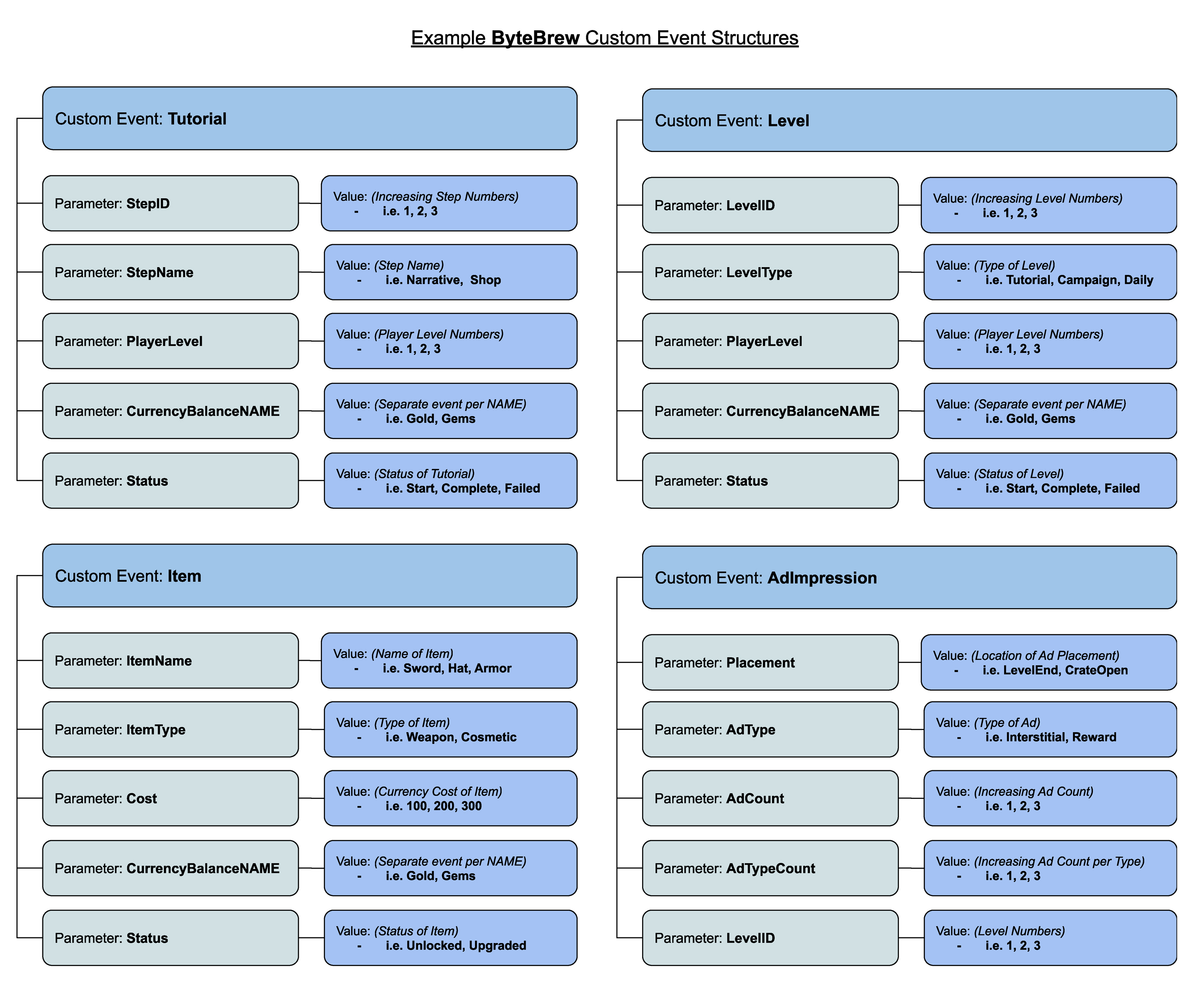
Custom Events
See samples below to see how to code Custom Events:
Custom event names and parameters that include special characters will not be processed on the dashboard. These events are unrecognized by ByteBrew and antipattern to ByteBrew's event structure.
Basic Custom Event:
                                    //Basic Custom Event without any sub-parameters
                                    ByteBrew.NewCustomEvent("eventName");

                                    //Basic Custom Event with a sub-parameter
                                    ByteBrew.NewCustomEvent("CustomEventName", "key_name=value;");

                                    //Examples
                                    ByteBrew.NewCustomEvent("GamePurchaseVC", "currency=GOLD;amount=500;character=viking;");
                                    ByteBrew.NewCustomEvent("LevelCompleted", "level=25;character=viking;");
Dictionary Custom Event Tracking Method:
To easily add additional custom sub-parameters to an event with a dictionary method using string "key_name=value;" pairs shown below:
                                //Key Value format "key_name=value;"
                                //Custom Events can take multiple pairs, "key_name1=value1;key_name2=value2;key_name3=value3;"
                                ByteBrew.NewCustomEvent("level_started", "weapon=megablaster;powerup=extralife;");
Remote Configs & A/B Tests
Remote Configs allow you to make updates to your app remotely without having to update your game's app store. Adding remote configs to your games are a fantastic way to be agile and send updates or patches to players instantly. Remote Configs are also utilized for creating A/B Tests on the platform.
When planning to integrate Remote Configs, We recommend implementing remote configs throughout all parts of your game to allow you to tweak and tune as you analyze your game performance data. See how to implement remote configs in your game by following the steps below:
Loading the Remote Configs
To use Remote Configs, you must first call for the config to get updated. You can call the below code whenever you want to update the configs:
                                    //Call the handler
                                    ByteBrew.LoadRemoteConfigs(new RemoteConfigListener() {
                                        @Override
                                        public void RetrievedConfigs(boolean b) {
                                              //Do Whatever you want here once the config is updated
                                        }
                                    });

                                    //Check if the remote configs are ready and set
                                    ByteBrew.HasRemoteConfigsBeenSet();
Retrieve the Configs
Once the handler has finished, you can call the remote config method below:
                                //Call to get the key specific value and if the key doesn't exist it will return the default variable specified, like if the AB test user is in the control group
                                String value = ByteBrew.RetrieveRemoteConfigValue("dailyWeapon", "goldRevolver");
Push Notifications
Using ByteBrew you can send cross-platform push notifications to your players around the globe. To get started with push notifications follow the steps below.
Integrate Push Notifications
Integrating Push Notifications with ByteBrew is super simple and only requires one line of code after initializing the ByteBrew SDK. See the Push Notification integration code line below:
ByteBrew.StartPushNotifications(this);
Create Push Notification App on the ByteBrew Dashboard
Go to the Push Notification dashboard on ByteBrew and create a new Push Notification App. See our Push Notification Dashboard documentation for step by step walkthroughs about this.
Push Notification Extra Settings (Optional Android Only)
Add a Custom Small Icon and Large Icon for push notifications.
Push Notification Android Manifest (Required Android Only)
<uses-permission android:name="android.permission.POST_NOTIFICATIONS"/>
Track Purchases
In ByteBrew SDK you can track all your game or apps in-app purchases to analyze your monetization performance on the dashboard. There are two ways to track purchases on ByteBrew. The first way is to use basic in-app purchase events. The second way is to use our real-time server-side purchase validation to validate real purchases vs. fraudulent transactions. See below to learn how to implement either method.
Track Basic In-App Purchases
To track in-app purchases in your game, use the below method:
ByteBrew.TrackInAppPurchaseEvent("Google Play Store", "USD", 5.99, "currencyPack01", "Currencies");
Track Validated Purchases
On ByteBrew, we offer a real-time server-side purchase validation to stop purchase fraud from client-side purchase receipt tampering that takes place in mobile games and apps. To utilize this validation you have two options: (1) a method with a callback to retrieve if a purchase was valid and (2) a method just to validate purchases without a callback. Follow below sections for code snippets for each function:
Purchase Validation with Callback
To track validated in-app purchases utilize the platform specific method. Using this method will create a purchase callback that will return a payload with the purchases details and verification status. See below for the Return Results and message definitions:
                                //Retrieve the Android receipt and Signature from the purchase event that occurs. We will validate it server side so you can view valid purchases in you dashboard.
                                String googleReciept = "...";
                                String googleSignature = "...";
                                ByteBrew.ValidateGoogleInAppPurchaseEvent("Google Play Store", "USD", 5.99, "currencyPack01", "Currencies", googleReciept, googleSignature, new PurchaseResponseListener() {
                                    @Override
                                    public void purchaseValidated(ByteBrewPurchaseResult byteBrewPurchaseResult) {
                                        Log.d("Purchase Processed: ", String.valueOf(byteBrewPurchaseResult.isPurchaseProcessed())); //Boolean telling if the purchase even went to the server to get checked
                                        Log.d("Purchase itemID: ", byteBrewPurchaseResult.getItemID());                              //Product/Item ID of the purchase processed
                                        Log.d("Purchase is Real: ", String.valueOf(byteBrewPurchaseResult.isPurchaseValid()));       //Boolean signaling if the purchase is real or fake
                                        Log.d("Process Message: ", String.valueOf(byteBrewPurchaseResult.getMessage()));             //Message from the server telling the explaination behind the decision
                                    }
                                });
Returned Results:
The following table are the possible returning results:
Returned Results Message:
In addition to the Return Result you will also recieve a message. See below for possible output messages and their definition:
"Validation Successful, real purchase.": This means that the message as a real purchase.
"Validation Failed, fake purchase.": This means that the purchase is fake or fraudulent.
"Error validating receipt, check game configs.": This message means that there might be an issue with the implementation. Check to make sure that the purchaseProcessed boolean is True and go to your game settings on the ByteBrew dashboard to update your Apple App Shared Secret and Google Play License Key.
Purchase Validation without Callback
To track in-app purchases using our validation system without looking for the purchase callback, utilize the platform specific method code snippets below:
                                    //Retrieve the Android receipt and Signature from the purchase event that occurs. We will validate it server side so you can view valid purchases in you dashboard.
                                    String googleReciept = "...";
                                    String googleSignature = "...";
                                    ByteBrew.TrackGoogleInAppPurchaseEvent("Google Play Store", "USD", 5.99, "currencyPack01", "Currencies", googleReciept, googleSignature);
Ad Tracking Event
Using ByteBrew you can track your game's or app's ad events. Tracking Ad Events will enable you to see breakdowns of your ads in the monetization dashboard. See the code snippets below to learn how to track ad events:
                                    // Record the Placement Type, Provider of the ad, ad unit name, and revenue of the impression
                                    ByteBrew.TrackAdEvent(ByteBrewAdType.Interstitial, "Google AdMob", "Interstitial_Unit_Name", 0.00074145);
                                    ByteBrew.TrackAdEvent(ByteBrewAdType.Reward, "Applovin Ads", "Reward_Unit_Name", 0.005562);

                                    //Add your ad units placement location in your game to breakdown your impression more.
                                    ByteBrew.TrackAdEvent(ByteBrewAdType.Interstitial, "Google AdMob", "Interstitial_Unit_Name", "Interstitial_EndOfLevel", 0.0024145);
Data Attributes
Data Attributes are tags in the SDK that you can give a user to define them for live ops functions. For example, you can use Data Attributes to tag user to build player segments to send targeted remote configs and push notifications. If you are looking to tag users for tracking and filtering, then use Custom Events with subparamters to track that type of update. See the following code snippets for examples on how to use Data Attributes:
                                ByteBrew.SetCustomData("dundees", 3);
                                ByteBrew.SetCustomData("loves_the_office", true);
Get User ID
GetUserID method in the SDK enables you to grab the current User ID of the user in your game. This is a handy method for finding the ID for a user you want to send a specific push notification to.
                                    // Get the string userID
                                    ByteBrew.GetUserID();
Stop Tracking Current User
In the ByteBrew SDK, you have the option to stop tracking any user in your game by calling the ByteBrew StopTracking method. This will immediately stop and disable any tracking for a user. As another alternative method to disabling tracking, you can build your own consent pop-up prompt screen in your game or app and delay the initialization of ByteBrew SDK until your user has consented/agreed to your prompt.
ByteBrew.StopTracking();
SDK FAQs
ByteBrew supports Android 5.1 and above.
ByteBrew has standardized events that are automatically tracked such as: install events and session events. These events are used throughout the platform to automatically calculate out-of-the-box metrics like: session length, playtime, retention and more.
here are several reasons ByteBrew does not cache offline player data such as:
(1) App File Size: For games tracking many parts of their apps, users playing offline will generate a significant file size of cached data that will inflate the app size on the device.
(2) Reduce App Crashes: If the storage of offline data becomes too large, the device will not be able to open the app on lower end devices and cause a potential app crash. ByteBrew is designed to make sure those issues do not exist for your game.
(3) Data Accuracy Tampering: Cached data from historical game session will get uploaded into the system the next time the user comes back online. This mean malicious users can tamper with your app's data, leading to potential issues with accurate reporting for you to operate from.
No, you can only use one push notification service or provider to send notifications at one time. However, if you are only using ByteBrew for our other services, then you can use another platform's push notifications SDK while still using ByteBrew SDK without any issues.
No, Push Notifications has it's own internal callback, so no other callback is necessary.
API Level 22 (Android 5.1)
A/B Tests deliver configs using your Remote Configs integration. Remote Configs delivered in milliseconds to your players after the ByteBrew SDK is initialized.
Yes, whether tracking in-app purchases or using Custom Events that send revenue parameters, the revenue you send should be in USD.
Find Test Ad Units you can use on the Ad Units docs page here.